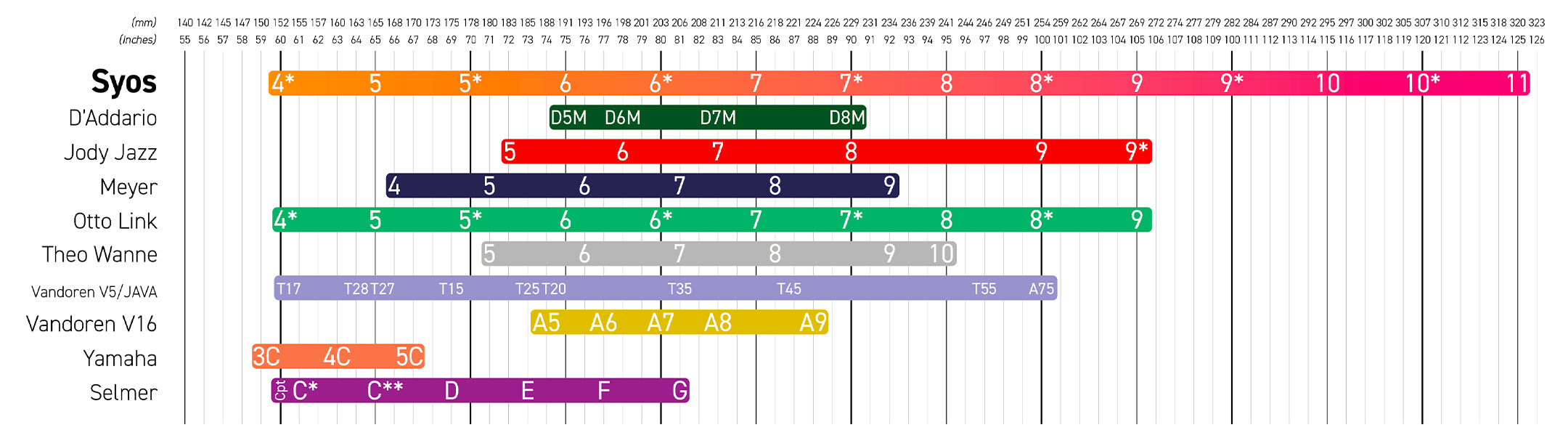
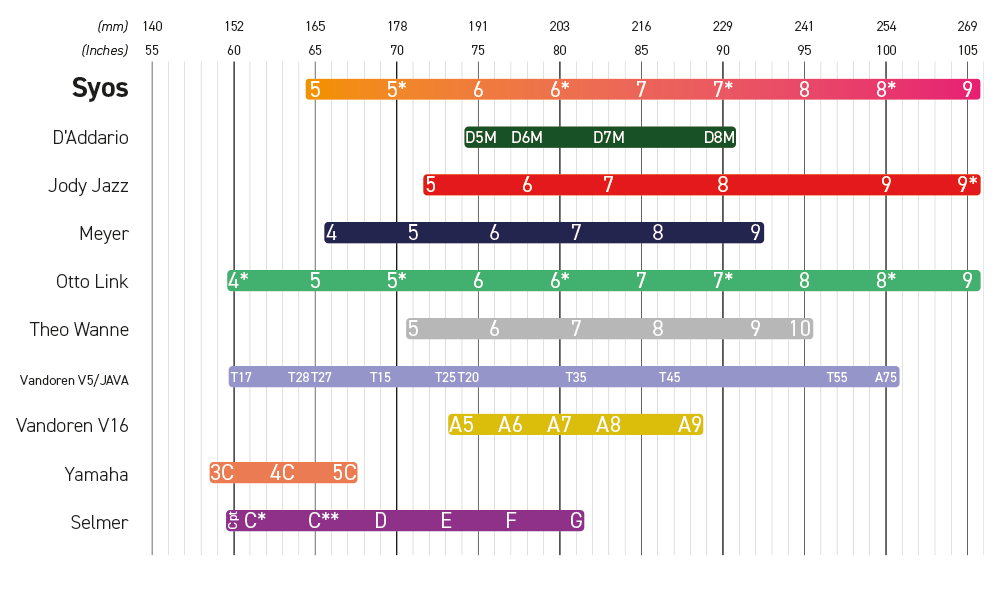
By the Syos acoustics team - we design custom saxophone mouthpieces and spend a lot of our working days measuring facings, tip rails, and baffles on an optical comparator. This guide is our attempt to put the numbers in one place.
TL;DR - What tip opening should I choose for alto sax?
There's no single right answer, but here's the shortcut:
-
Classical or beginner: stick to a 1.55–1.75mm (0.061"–0.069") tip opening (think Selmer S80 C* at 1.55mm / 0.061").
-
Versatile, all-round playing (school band, function gigs, some jazz): 1.75–1.90mm (0.069"–0.075") is the sweet spot.
-
Jazz: most working players land between 1.85mm and 2.16mm (0.073"–0.085") - the Syos alto mouthpiece, for example, ships at 1.91mm (0.075", tip opening 6).
-
Contemporary, funk, rock, or a big screaming lead sound: 2.00mm and up (0.079"+), sometimes well past 2.30mm (0.091").
Wider tip openings preferably need softer reeds and more air; narrower ones reward control and are easier on the embouchure. If you're not sure, 1.80–1.90mm (0.071"–0.075") with a medium reed (2.5–3) is the safest place to start experimenting.
Below, we break down the full alto saxophone mouthpiece tip opening chart by brand and by playing style, and explain what actually changes when you go up or down in opening.

What is "tip opening" and why does it matter?
The tip opening is the gap between the reed and the tip of the mouthpiece when the reed is laid flat against the table. It's measured in millimeters (or thousandths of an inch in the US: 0.001" ≈ 0.0254mm), and it's the single number that most affects how a mouthpiece feels and sounds.
Here's the mechanic in plain terms:
-
A wider tip opening lets more air move past the reed per cycle. That gives you a bigger, edgier, more resistant-feeling sound with a wider dynamic range - but it demands a softer reed and stronger embouchure control, or the reed simply won't vibrate cleanly.
-
A narrower tip opening brings the reed closer to the tip rail. It's easier to control, speaks faster at soft dynamics, and generally sounds more centered and classical - but it caps how loud and bright you can push the sound before it flattens out.
-
Airflow and resistance are directly tied to the opening, but the reed decides which way it tips. A narrow opening paired with a soft reed tends to sound a bit nasal; a wide opening paired with a strong reed will sound really airy. Tip opening and reed strength are always a pair, never a solo act.
-
Brightness can be influenced by tip opening, but it's actually one of the least important factors. Chamber size and baffle height do most of the work in shaping how bright or dark a mouthpiece sounds - tip opening comes after that. Two mouthpieces at 1.90mm can sound completely different if one has a high baffle and a small chamber and the other doesn't.
Brands use numbers or letters to describe the tip opening, but on their own those figures don't tell you much: facing length (the curve length from tip to where the reed touches the table) changes how open a mouthpiece actually feels in the mouth. Yet facing length is almost never talked about - unlike tip opening, there's no number that's ever indicated for it. A mouthpiece with a shorter facing will feel more open than another mouthpiece at the exact same tip opening but with a longer facing. There's no fixed pairing rule here either - a given facing length can work with any tip opening, short or wide; it's a question of design, not a rule to follow.
Alto sax tip opening chart by playing style
Use this as a starting map, not gospel. Reed strength, facing length, and your own embouchure shift where you'll actually land.
|
Playing style
|
Tip opening range
|
Typical reed strength
|
Feel & tone
|
|
Classical / beginner
|
1.55–1.75mm (0.061"–0.069")
|
2.5–3.5 (softer reeds)
|
Easy response, centered, controlled - built for tone consistency across registers
|
|
Versatile / all-round
|
1.75–1.90mm (0.069"–0.075")
|
2.5–3
|
Balanced brightness and resistance - the default for school bands, function work, pit gigs
|
|
Jazz
|
1.85–2.16mm (0.073"–0.085")
|
2–2.5 (softer)
|
More edge and projection, room to bend and growl, needs a looser embouchure
|
|
Contemporary / funk / rock / lead alto
|
2.00mm and up (0.079"+)
|
1.5–2.5 (often quite soft)
|
Big, loud, resistant sound built for cutting through a band; demands serious air support
|
These bands overlap on purpose - a 1.90mm piece can be a jazz mouthpiece or a versatile one depending on chamber and baffle. Tip opening tells you the ballpark, not the exact address.
Reference tip openings from major brands
Real numbers help more than ranges. Here's how some widely-played alto mouthpieces measure up, gathered from published facing charts and manufacturer data:

|
Brand / model
|
Tip opening
|
Category
|
|
Selmer S80 C
|
1.45mm (0.057")
|
Classical
|
|
Selmer S80 C*
|
1.55mm (0.061")
|
Classical (industry reference point)
|
|
Selmer S80 C**
|
1.65mm (0.065")
|
Classical
|
|
Selmer S80 D
|
1.75mm (0.069")
|
Classical / versatile
|
|
Otto Link 5 (hard rubber)
|
1.65mm (0.065")
|
Versatile
|
|
Otto Link 5*
|
1.78mm (0.070")
|
Versatile
|
|
Meyer 5
|
1.80mm (0.071")
|
Versatile
|
|
Syos Alto Mouthpiece
|
1.91mm (0.075") - tip opening 6
|
Jazz / versatile crossover
|
|
Otto Link 6
|
1.91mm (0.075")
|
Jazz
|
|
Meyer 6
|
1.93mm (0.076")
|
Jazz
|
|
Meyer 7
|
2.05mm (0.081")
|
Jazz / contemporary
|
|
Otto Link 7*
|
2.29mm (0.090")
|
Contemporary / funk
|
|
JodyJazz (full alto range)
|
1.68mm to 2.54mm (0.066" to 0.100")
|
Classical to extreme lead-alto
|
|
Otto Link 8*
|
2.54mm (0.100")
|
Extreme / lead alto
|
A few things jump out from this table:
-
1.91mm (0.075") keeps coming up - Otto Link's 6 sits there, and so does our own tip opening 6, one of our best-sellers. It's a well-worn spot for players who want jazz punch without giving up control - Patrick Bartley and Marshall McDonald both play at this opening.
-
Alto mouthpieces rarely go past a tip opening of 8 across any brand - most catalogs top out there, even their widest lead-alto pieces. At Syos we can always push further on a fully custom order: our record stands at a tip opening of 20, or 5.46mm (0.215").
-
Selmer's S80 C at 1.55mm (0.061")* is probably the most-referenced classical tip opening in the world; it's the mouthpiece most conservatory students start on.
How reed strength interacts with tip opening
This is the part players get wrong most often: tip opening and reed strength are a single decision, not two.
-
Wide tip opening + hard reed = the reed barely moves, response is stuffy, high notes crack. This is the classic "I bought a jazz mouthpiece and it plays terribly" complaint - the reed is almost always too strong for the opening.
-
Narrow tip opening + soft reed = the reed flaps against the tip rail, sound gets thin, buzzy, and unstable, especially in the altissimo.
-
The matching logic: as tip opening goes up, reed strength should come down. A player on a 1.55mm (0.061") Selmer C* might use a 3 or 3.5 reed; the same player switching to a 2.00mm (0.079") jazz mouthpiece will usually need to drop to a 2 or 2.5 to keep the same resistance and response.
If a new mouthpiece feels harder to play than your old one, check the reed before blaming the mouthpiece. Nine times out of ten, a half-step softer reed fixes it.
How to choose your tip opening
-
Start from your current setup. If you play a 1.65mm (0.065") mouthpiece with a 3 reed and it feels comfortable, don't jump straight to 2.10mm (0.083") - try 1.85–1.90mm (0.073"–0.075") first.
-
Match the opening to the music. Concert band and classical solo work reward control (narrower); jazz combo and big band lead work reward projection (wider).
-
Drop reed strength when you go wider. Expect to lose half a reed strength for every ~0.15–0.20mm (0.006"–0.008") increase in tip opening.
-
Give it two weeks before judging. Embouchure muscles adapt. A mouthpiece that feels too open in week one can feel perfect by week three, once your air support catches up.
-
Try before you buy when you can. Published mm figures are a great filter, but facing curve, chamber, and baffle shape all change how a given tip opening actually plays. Our best alto saxophone mouthpiece picks are a good place to compare options side by side.
Frequently asked questions
What tip opening is best for beginners? Somewhere in the 1.55–1.75mm (0.061"–0.069") range. It's forgiving, speaks easily at soft volumes, and doesn't demand strong embouchure control yet. The Selmer S80 C* (1.55mm / 0.061") is the classic beginner-to-intermediate reference. Our beginner's guide to choosing a saxophone mouthpiece covers the rest of the decision beyond tip opening.
What tip opening do jazz players use? Most working jazz altoists sit between 1.85mm and 2.16mm (0.073"–0.085"), paired with a softer reed (2 to 2.5). Go past 2.16mm (0.085") and you're moving into specialist lead-alto or funk territory rather than general jazz combo playing.
Does tip opening affect intonation? Yes, indirectly. A more open mouthpiece will tend to run a bit flat, especially without enough air support to back it up, while a narrower opening paired with a too soft reed can push upper-register notes sharp and hard to control. Intonation problems tied to tip opening are almost always really a reed-matching problem - get the pair right and pitch stability follows.
Can I change tip opening without changing the whole mouthpiece? Not really - tip opening is baked into the facing curve during manufacturing. Some techs can adjust it slightly by reworking the tip rail, but it's a specialist repair job, not a DIY tweak. See our guide to changing tip opening for more on what's actually possible.
Is a bigger tip opening always louder? Not automatically. Volume comes from air support and reed vibration efficiency as much as tip opening. A wide-tip mouthpiece with too hard a reed can actually sound quieter and stuffier than a well-matched narrower setup.
Useful sources